
Have you ever noticed how loudly you sometimes have to speak while your cycling buddy is riding right next to you? How loud is wind noise on the bike really, can it be harmful, and can you prevent it?
During a ride with a strong headwind, I suddenly noticed that I was shouting a lot and often had to ask what my buddy was saying. It raised the question of how much noise was actually passing my ears and whether it could be harmful. The answer turns out not to be simple, but we will try.
Research on hearing damage in cycling
In the search for more information on this topic, I found only one reasonably scientific study. In 2017, an American ear specialist conducted a test in a special wind tunnel designed to produce as little noise as possible. A test subject was placed on a bicycle, fitted with a helmet, and tiny microphones were attached near both ears to measure sound levels. These were calibrated with a baseline measurement so they would only capture wind noise. The subject was then exposed to various wind speeds from different angles. The results show quite alarming noise levels.
What is hearing damage
This raises the question: what exactly is hearing damage? According to the World Health Organization, your hearing is impaired if you cannot perceive sounds around 20 decibels, comparable to someone whispering at two meters. A normal conversation is around 60 to 70 dB. Besides reduced hearing, there is also tinnitus, a constant ringing or noise in your ears without an external source. About 15 percent of the world’s population experiences this to some degree. It can be caused by prolonged exposure to excessive noise.
It is not just about how loud a sound is, but also how long you are exposed to it. Together, these determine the overall sound load. Frequency also plays a role, as the human ear perceives low-frequency sounds much quieter than mid-range frequencies. That is why dB(A) values are used, correcting sound levels to human hearing sensitivity.
Safe soundlevels
| WORK | FREE TIME | |||
|---|---|---|---|---|
| Soundlevel (dB(A)) | Hours a day | Days a week | Soundlevel (dB(A)) | Hours a day |
| 80 | 20 | 2 | 88 | 20 |
| 83 | 10 | 2 | 91 | 10 |
| 86 | 5 | 2 | 94 | 5 |
| 89 | 2 hours, 30 min | 2 | 97 | 2 hours, 30 min |
| 92 | 1 hour, 15 min | 2 | 100 | 1 hour, 15 min |
| 95 | 35 min | 2 | 103 | 35 min |
| 98 | 17 min | 2 | 106 | 17 min |
| 101 | 8,5 min | 2 | 109 | 8,5 min |
The above table shows that it’s not advised to be exposed to 94 dB(A) for longer then 5 hours (max 2 days a week).
When does wind noise become dangerous
To determine whether cycling exposes you to dangerous noise levels, we can look at wind tunnel data. With a moderate headwind of about 15 km/h and a cycling speed of 30 km/h, you experience wind at 45 km/h over your helmet. This can result in around 100 dB of noise.
Interestingly, a tailwind of the same strength can reduce noise by about 15 dB, although you may end up riding faster.
Despite these high values, very few cyclists report hearing damage. This may be because wind direction constantly changes, exposure is rarely continuous, and helmets and ear shapes differ. Hearing damage also develops gradually, making it difficult to pinpoint cycling as the cause.
Can You Protect Your Hearing While Cycling
Riding with earplugs is not ideal, as it reduces awareness of traffic. Some cyclists use products like Cat-Ears, small covers attached to helmet straps to reduce turbulence and noise. They help slightly, but do not eliminate the problem.
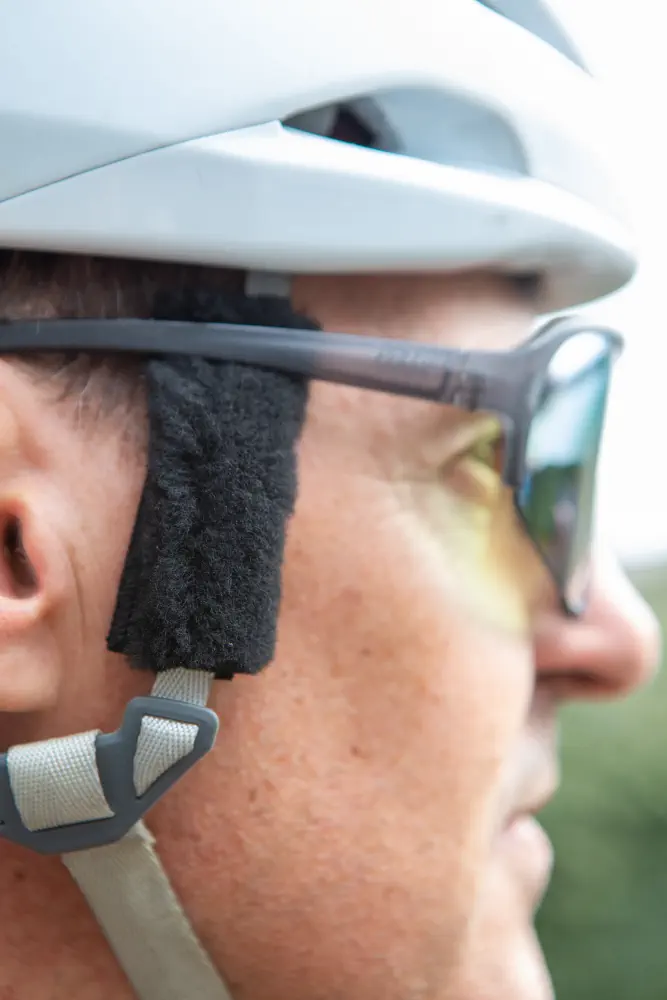
Helmet manufacturers are also exploring solutions. Some designs extend over the ears to reduce turbulence and improve perceived sound clarity. For example POC with their Procen AIR helmet.
Conclusion on wind noise while cycling
It is difficult to draw firm conclusions without consistent measurements. If you have to shout to communicate during a strong headwind, it is safe to assume your ears are exposed to high noise levels. Whether this requires action is a personal choice, but protecting your hearing is sensible.
One key insight is that noise is often louder on the leeward side of your head due to turbulence. The difference can be as much as 20 dB. During fast descents, noise levels can even reach 120 dB, which is high enough to cause immediate damage. So it is worth being cautious!
About the Author